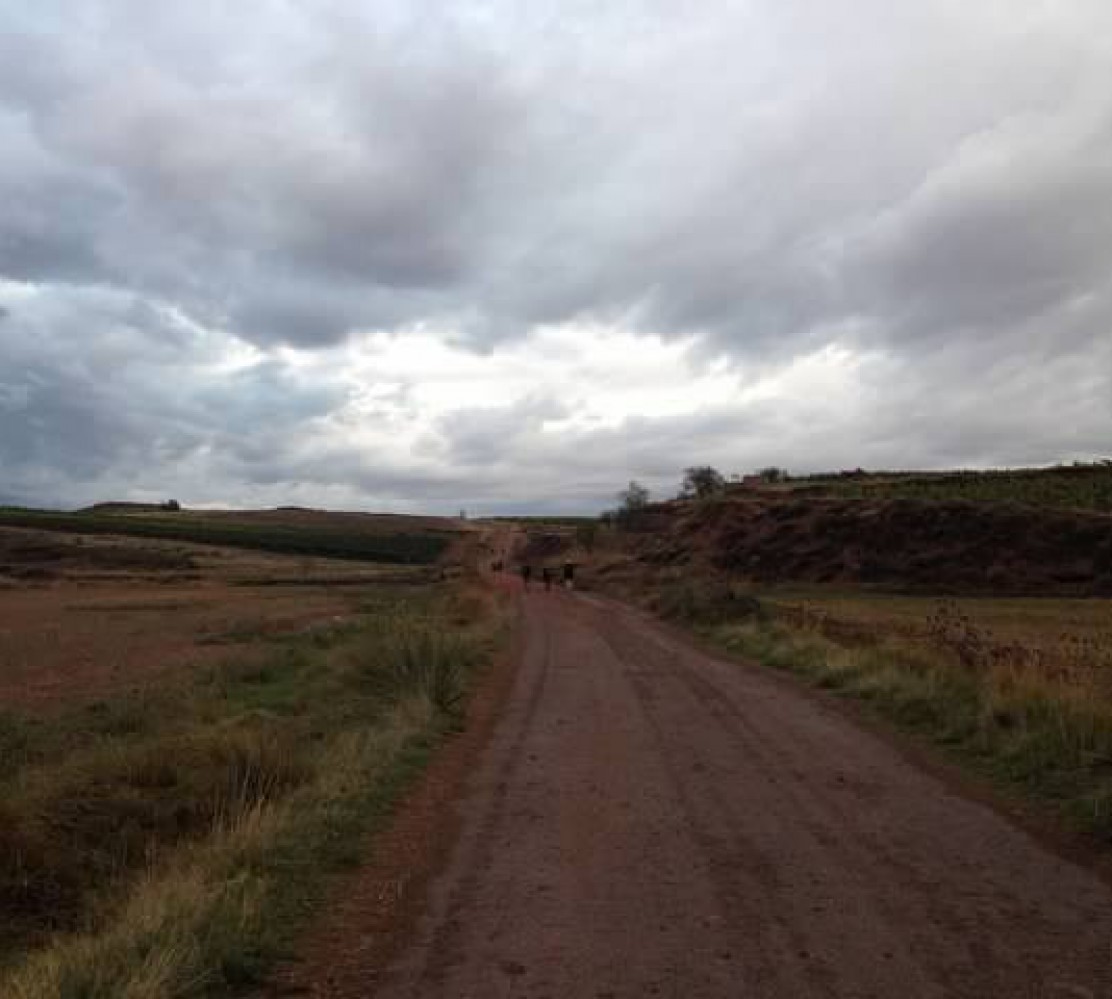
The Shell of the Camino

Hanging on every backpack on the Camino is the shell. The reason it became a symbol of the Camino is a mixture of legend and symbol. St James, “Santiago” in Spanish, was the first of the apostles to have been martyred for his faith in Christ. It is believed that James traveled to Spain to teach the gospel. After spending time in Spain spreading the Good News, he returned to the Holy Land and was then martyred.

After his martyrdom, a few disciples brought his body back to Spain and it is believed the sea shell filled the shore line along the ocean in Spain. Another legend says a “figure” of a man covered in sea shells emerged from the waters and walked on the beach front, supposedly being James.

It is believed that the body of James was buried in a field and discovered in the seventh or eighth century and the cathedral was built over the spot of burial. Venerating his bones became the purpose of creating the pilgrimage. More likely, the pilgrimage was created by the church to attract countless Christians to journey to Spain, “re-conquering” Spain from the Moors or Muslims.

In all likelihood, the shell became a symbol of the Camino simply because of its association with baptism, the shell being used to pour the waters of baptism over the individual’s head. And Jesus called the first disciples along the seashore, the place where shells wash in from the depths of the ocean.

The legends are interesting but the truth much more enriching.

What goes into Backpack

My backpack is a 65L Osprey, way too large but I had to exchange my 55L for the 65L. Most pilgrims use less than 50L but this is just too small. Because I’m walking mainly in November, I need clothes for two seasons. My medication, alone, ways nearly 3 pounds. My pack contains:

A second set of clothing for each day: shirt, t shirt, underwear and sox, plus a pair of thin long underwear a pair of long sleeve undershirts. It’s all about layering. Temps go from 35-65 degrees.

Toiletries, blister treatment, laundry detergent, electrical, phone cords and a charger, flip flops, rain jacket and pants, light weight down jacket, hat and gloves, small head lamp, liter container for water, walking shoes for evenings, all medications, travel bag for checked backpack, extra pair of wool socks, small chalice, plate and hosts for Mass.

Pack weight neatly 27 pounds, including water.

Wish me luck.

Follow the Yellow Arrows

Many people ask me how do you know where you are going for 500 miles? Do you get lost? The answer to the last question is a resounding YES, one can get lost. In terms of how do you make it all the way to Santiago from the French/Spanish border?

Simple. Follow the yellow arrows. All along the way, on tree trunks, along the path, on walls of houses or restaurants are yellow arrows painted or spray painted along the pathway. “Keep your eyes open,” is the key mantra, especially when there is the ubiquitous “fork in the road,” and there are many.

In the 1980’s, a priest actually made it his mission to paint yellow arrows all along the way at various intervals. Also, there are metal signs with the arrow or a shell, which is a symbol of the Camino, pointing the way. Many of the larger towns or cities have metal shells embedded in the pavement. Before that, you were on your own. The key to remember: make sure you are walking West

Buen Camino.

getting ready

It’s just over three weeks until the Camino journey begins. I’m slowly getting into the training, which is going rather slowly. My last Camino was over 8 years ago, which means I’m a lot older. And it feels like it. As the day draws nearer, I’m opening myself up more in prayer, asking Christ to lead me. My hope is that the journey is rooted in a purpose that will unfold as I walk. Please keep me in prayer that the Camino helps to raise necessary funds for our Outreach Ministries. We are off to a good start with nearly $3,000 donated.

To donate, go to Give Central https://www.givecentral.org/customizable-online-giving/209-St_Teresa_of_Avila and find “frfrankscamino” and donate there.

Streams of Living Water. February 28, 2019

“Like streams of living waters,” a beautiful verse from the psalms and John’s gospel, pointing each one of us deep within our hearts. These waters are the Spirit, flowing in the subterranean depths of our beings, waiting to be let go. Lent is the season to tap into these flowing waters of life and love. Prayer, fasting, and helping the poor are ways to go deep. Lent is all about letting the waters of Baptism out of their enclosed recesses and into our consciousness. Transformation. Beauty. Truth. These are the gifts that help us RISE with the Risen One. We are all destined for an eternal Easter. We are an Easter People!!!

Peace. Fr. Frank

Viral Social Media. January 21, 2019

When social media goes viral it can destroy lives. Yesterday before the 9:00 Mass, I read in the news feed about an incident captured on a phone video showing a verbally violent scene depicting a group of men shouting a variety of hateful rhetoric to the people around them. A group of teenagers from a Catholic high school ,on their way to the Match For Life in Washington, engaged these hostile men. While there was no physical violence, the small group of men representing a fringe group taunted the people and a Native American man present at the scene, began to chant and beat his drum, trying to defuse the situation.

It “appeared” on the video that the high school students were mocking this Native American, with one young man staring at him with a smile on his face. Immediately, the report stated that these high school students were shouting racially insensitive comments. The image of this young man staring down the Native American went viral, depicting him as contributing to a racially charged incident. The Catholic high apologized for their abhorrent behavior.

But a viewing of the entire video depicts a much more nuanced explanation. The young man, himself, defending his action saying he was just trying to be a peaceful presence. Unfortunately, millions of people saw the short video with no context and rushed to judgements. I reported the incident at mass after reading the apology issued by the authorities st the high school.

This young man and his family have encountered death threats and horribly violent language. Whatever happened, we only got a tiny snippet of a video with a judgement by people who didn’t see the whole video or wished to depict these catholic youth in a negative light.

Lives can be destroyed when images and videos are posted with literally no thought. These social media posts can literally haunt a person when trying to get into a college or search for a job. We all have to be careful how we carry ourselves in public and in large gatherings. People love to capture an image of something that will attract followers and with multiple responses. Little care is given to the ramifications or consequences. Some individuals have even resorted to suicide when they feel totally overwhelmed and trapped.

Social media is here to stay and has a vital role to play in conveying information and telling stories. But it must never be used to destroy people’s lives. When confronted by a group of individuals saying hateful things, it’s best to simply quietly move on, never engaging these deranged people. It’s impossible to have a rational discussion with people who have no conscience.

Peace. Fr. Frank

Journey of Migrants. January 6, 2019

Epiphany is about a journey, or several journeys, across lands and nations, guided by the light of a star. Their journeys lead to a child who promises to be a unifying force of love and justice for ALL people and nations. The Magi leave the child no longer looking in the skies for a guiding light, but within their hearts. These “foreigners” became believers and disciples of Christ, while the religious leaders of this Child denied Him. Epiphanies are experiences that enlighten, open up, our minds and hearts to God. This encounter compels us to “see” differently, taking new routes.

Millions of human beings are compelled to take new routes leaving their Homeland out of desperation, to simply survive forces of violence and poverty. It is easy for us who are comfortable and have the ability to freely choose to be mobile, changing routes to make life more meaningful. But if you are facing poverty, gang violence and human trafficking, crossing borders, legally or illegally, becomes the only option. You will do anything to protect your children. You will do anything to feed them and care for them if they are ill.

Migration has been a part of humanity, throughout our history, going back indefinitely. People leave countries to find freedom and the ability to follow dreams and desires. But abuse of power and unjust economies rooted in historical patterns of colonialism, are just two realities that FORCE people to migrate. Human rights: the right to have food, shelter, education and medical care are just the basic human rights which must be accorded to every human being. When these rights cannot be realized, instability results.

The problems of migration and immigration are complex and divisive. The ultimate solution is not in building high walls, even if the wall prevents desperate people from entering. They will find other ways. Simply preventing people from entering illegally will not solve the problem. It may even make matters worse. Getting to the root of the problem is the only solution: confronting the various injustices related to the economy, agriculture, imports, exports, land acquisition, to name a few. And ALL nations have contributed to these injustices, including our own.

Foreigners from the East got the message and changed their entire lives forever. All of us are rooted in other nations and cultures. Migration is a part of every human being’s history and this county of America was founded on welcoming immigrants. Those of us who love and follow Christ are called to a higher standard, the standard of the gospel. We are called to welcome the stranger and in doing so, we encounter Christ.

Peace. Blessed Epiphany, especially our Migrants…our neighbors.

Advent Confession December 11, 2018

I’m actually writing this reflection waiting for anyone to come to Reconciliation or Confession. The wait is a quiet one before the Blessed Sacrament with just a few people coming to pray. Waiting can be a lonely experience if you’re expecting a particular outcome and you are focused on that outcome which never quite materializes. In our waiting we sometimes make demands in God: finding the right friend or partner; healing from illness; successful career; happiness. The list is endless.

Advent teaches us to wait simply being aware of God’s presence and offering our prayers and desires not as expectation to be fulfilled but as a way of talking with God, being open and vulnerable. But we must listen for God’s response and surrender to it. Letting go of our own will is what can possibly happen in the waiting.

The people were waiting for the messiah and He came but not as they expected. Being born in a smelly cave in obscurity, no one being aware except shepherds, the lowliest people at the time. They were actually despised as being outsiders. The people waited centuries for this??? We forget how radical the birth of Christ was and how it perplexed so many. We don’t even know the date, the year, the month, even the actual place of His birth.

And so we continue to wait for Christ to enter our lives in ways we don’t expect. Let’s be surprised and open as we wait. Speak our prayers and needs but let them go. Listen to God speaking to us answers we may not expect or want. So be it.

I’m waiting here for people. If they show… great. If not, I’ve written this reflection, which is just fine.

Peace. Fr. Frank

St. Nicholas. December 6, 2018

From St. Nicholas to Sinter Claus to Santa Claus…this wonderful man, forerunner to our Santa Claus, was a bishop in a village called Myra, in what is now Turkey. This saint has a scant biography: came from wealthy, family, loved his faith, became a priest and bishop. It is likely he actually attended the first ecumenical council of the Church: the Council of Nicaea that gave us our Nicene Creed which we pray every Sunday and Holyday. His name, “Nicholas of Myra” appears on the roster of those who attended the Council, though no record exists that he said anything during the deliberations.

The one incident in his life that cannot be verified historically is that he helped a poor couple with three daughters by secretly giving a dowry in the form of gold to each of the daughters. Hence, he became associated with secretly giving gifts. After his death, many legends of Nicholas began to be told: calming of turbulent waters, healing miracles and countless other stories clearly not historical but are testaments to the saint’s popularity. Thousands of churches are named after this beloved saint. Many cities and even countries have Nicholas as their patron.

Nicholas lived a humble life on the rock of Christ. His life was all about selfLESS giving, the heart of our devotion to Santa Claus. If we and our children are to emulate Nicholas, we best do so by giving generously giving to those in need. We teach our children by example when we ask Santa not just what gifts we can get, but what gifts we can give.

The symbols of Nicholas: boot or shoe, since children would put food and treats for Nicholas’s horse or donkey in shoes placed on roadside; candy cane, symbol of Bishop’s crozier or staff; boat or ship, since he is patron of sailors (Myra, his village, was a sea coast town); anchor, due to his ministry to sailors; three gold coins, symbolizing the three poor daughters and their dowries.

If you can have something sweet, do so to celebrate this wonderful Saint. Don’t worry about processed sugar, simply enjoy.

Peace. Fr. Frank